ERV vs HRV: Which Fresh-Air System Is Right for Your Home?
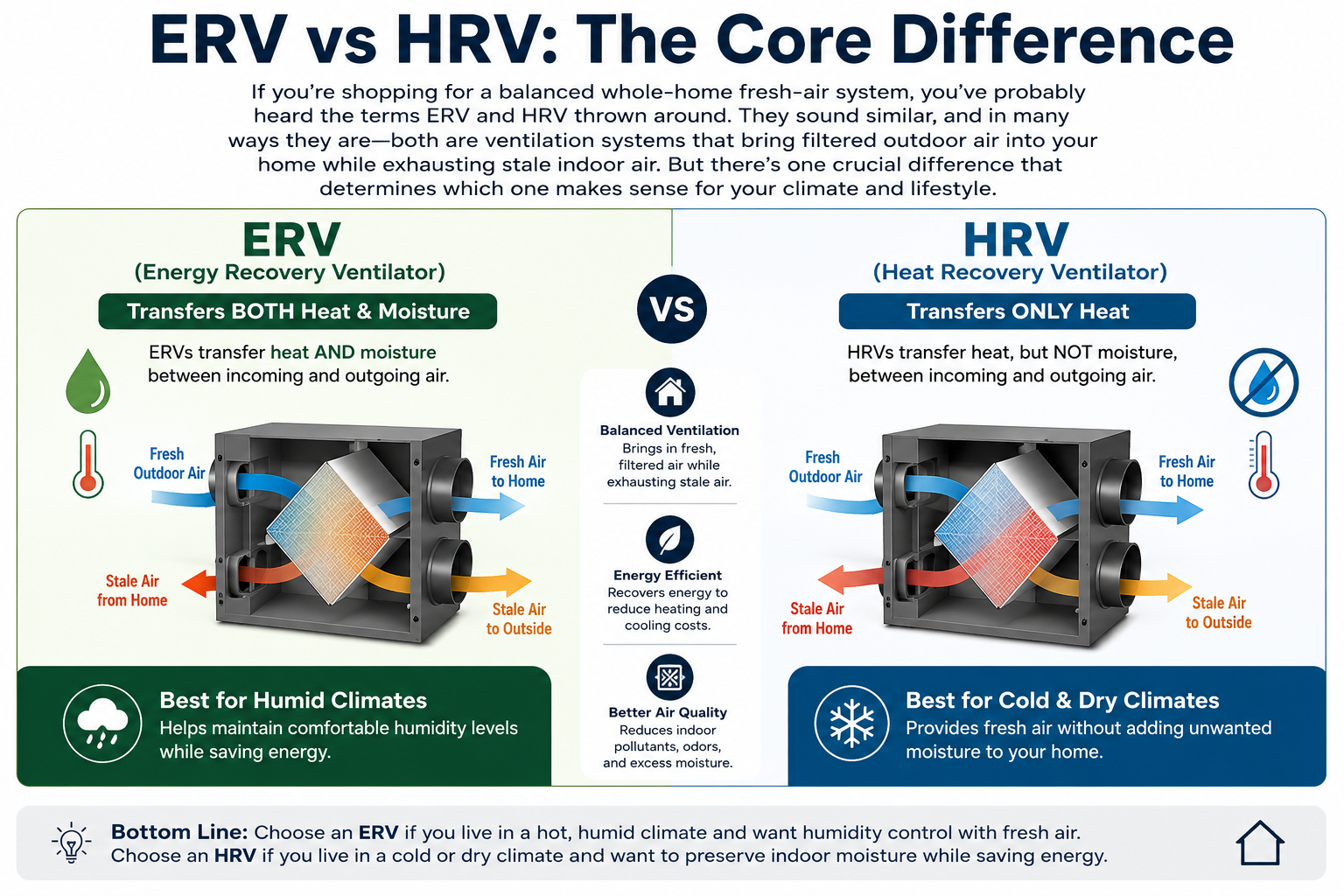
ERV vs HRV: The Core Difference
If you're shopping for a balanced whole-home fresh-air system, you've probably heard the terms ERV and HRV thrown around. They sound similar, and in many ways they are—both are ventilation systems that bring filtered outdoor air into your home while exhausting stale indoor air. But there's one crucial difference that determines which one makes sense for your climate and lifestyle.
An HRV (heat recovery ventilator) transfers heat between incoming and outgoing air. An ERV (energy recovery ventilator) transfers both heat and moisture. That single distinction ripples through performance, efficiency, and comfort in ways that matter more than you might think.
How HRV Systems Work
An HRV uses a heat exchanger core to capture warmth from the air you're exhausting (from bathrooms, kitchens, and living spaces) and transfers it to the cold fresh air coming in from outside. In winter, this preheats incoming air so your furnace doesn't have to work as hard. In summer, it works in reverse—cooler indoor air cools down the warm outdoor air before it enters your home.
The result: you get fresh air without the heating or cooling penalty. HRVs are especially effective in cold, dry climates where outdoor humidity is low and heating costs are high.
- Best for: Cold winters, low outdoor humidity, climates where heating dominates your energy bill
- Heat recovery efficiency: Typically 70–85%
- Key benefit: Maximum heating/cooling savings in extreme cold
- Consideration: Does not manage indoor humidity
How ERV Systems Work
An ERV goes a step further. Its core transfers both sensible heat (temperature) and latent heat (moisture). This means in summer, an ERV removes humidity from incoming outdoor air, and in winter, it retains moisture in the air you're bringing in.
Why does that matter? Homes in humid climates struggle with excess indoor moisture—mold, mildew, dust mites, and discomfort. An ERV actively pulls that moisture out before it enters your living spaces. In dry climates, an ERV preserves indoor humidity, preventing the dry skin, static, and respiratory irritation that plague winter living.
- Best for: Humid climates, mixed climates with both heating and cooling needs, homes sensitive to moisture
- Energy recovery efficiency: Typically 60–80% (slightly lower than HRV because moisture transfer requires more work)
- Key benefit: Active humidity control year-round
- Consideration: Slightly higher upfront cost than HRV
Climate: The Real Decision-Maker
Your climate is the single biggest factor in choosing between ERV and HRV. Think about your year-round air challenges.
Cold, Dry Climates
If you live where winters are long and outdoor humidity is consistently low (Minnesota, Colorado, parts of Canada), an HRV is the workhorse. You'll maximize heating savings, and you won't struggle with excess outdoor moisture entering your home. Your indoor air may be drier in winter, but that's manageable with a humidifier if needed—and you control it.
Hot, Humid Climates
If your summers are long and sticky (Florida, Louisiana, Southeast), an ERV earns its keep. The system actively removes outdoor humidity before it enters your home, which means less work for your air conditioner and a more comfortable indoor environment. You'll also avoid the mold and mildew risks that come with high indoor humidity.
Mixed or Temperate Climates
If you experience both heating and cooling seasons with variable humidity (most of the continental U.S.), an ERV is often the safer choice. It handles both extremes—removing excess summer humidity and preserving winter moisture—without you having to adjust settings seasonally. The flexibility pays dividends over time.
Efficiency and Operating Costs
Both systems save energy by pre-conditioning incoming air, but the math differs slightly.
An HRV typically recovers 70–85% of sensible heat. If you're bringing in 50°F air and your home is 70°F, the HRV might deliver air at 60–65°F, dramatically reducing furnace load. Over a winter, that adds up to measurable savings.
An ERV recovers 60–80% of total energy (heat plus moisture). It's slightly less efficient at pure heat transfer because the moisture-exchange core adds resistance. But in humid climates, the humidity control reduces air-conditioning runtime, which often offsets the difference—or even tips the scales in the ERV's favor.
Real-world takeaway: In most climates, the difference in annual operating cost is modest. The bigger savings come from having the right system for your climate, not from squeezing an extra 5% efficiency out of the wrong one.
Maintenance and Durability
Both ERV and HRV cores need periodic cleaning—typically every 6–12 months, depending on your filters and air quality. An ERV core may require slightly more attention because the moisture-transfer medium can accumulate mineral deposits in hard-water areas. But with standard maintenance, both systems last 15–20+ years.
The key is using good pre-filters and keeping your system clean. A clogged core works harder, uses more energy, and delivers less fresh air. Neither system is significantly harder to maintain than the other.
Fresh-Air Ventilation for Your Home
Whether you choose ERV or HRV, the core mission is the same: deliver continuous, filtered fresh air while managing energy loss. Our ERV vs HRV comparison page puts both side by side against fans, windows and your existing HVAC, and the ERV sizing CFM table shows the airflow your bedroom count calls for. A balanced whole-home system ensures every room gets adequate ventilation without the drafts or noise of window-unit air exchangers.
At UpgradeAirKit, we offer complete ERV and HRV kits with a LifeBreath core, Zehnder manifolds, and 3" tubing sized for typical homes. Not sure which is right for you? Use our Free System Match tool to get a recommendation based on your climate and home size.
Frequently Asked Questions
Can I use an HRV in a humid climate?
Technically yes, but it's not ideal. An HRV won't remove excess outdoor humidity, so in summer your air conditioner has to work harder to dehumidify incoming fresh air. Over time, you may also see mold or mildew in ducts or around exhaust points. In humid climates, an ERV's active dehumidification is worth the investment.
Will an ERV dry out my home in winter?
No. An ERV preserves moisture from outgoing indoor air and transfers it to incoming outdoor air, so winter humidity levels stay stable. You won't experience the dry skin, static, or respiratory irritation common in homes with HRV-only systems in cold climates.
How much does an ERV or HRV system cost?
Read from our live catalog as this article was written, a complete UpgradeAirKit balanced fresh-air system — ERV core, Zehnder manifolds, duct and registers — runs from $5,460 to $9,115, and what moves you along that range is port count, not quality. If you already own a working core, a distribution-only kit starts at $1,920. Installation is not included in a kit, and labor is quoted separately by your installer. An ERV typically carries a modest premium over a comparable HRV, but the humidity control and year-round comfort often justify the difference in mixed or humid climates.
Which is better for a bedroom, ERV or HRV?
For a bedroom, what matters most is that fresh air is actually delivered into the room and that the unit is quiet. Both an ERV and an HRV can do that, provided the system is balanced and ducted to each bedroom rather than relying on air drifting under a closed door. In mixed and humid climates an ERV is usually the better bedroom choice, because it moderates the moisture coming in overnight; in a very cold, dry region an HRV paired with a humidifier can work just as well. Size the system by bedroom count either way.
Does an ERV work in a cold, dry climate?
Yes. An ERV keeps working in cold, dry weather, and its moisture-transfer core holds back some of the humidity from the outgoing air instead of sending it outside, so indoor air does not get as dry as it would with an HRV. In very cold regions, look for a unit with a frost-protection or defrost strategy, since any recovery core can frost up when outdoor temperatures fall well below freezing. In the coldest US climate zones — 7 and 8 — the 2021 IECC in fact requires a balanced heat or energy recovery ventilator.