Radon and Dust: How Filtration Helps Remove Radon Decay
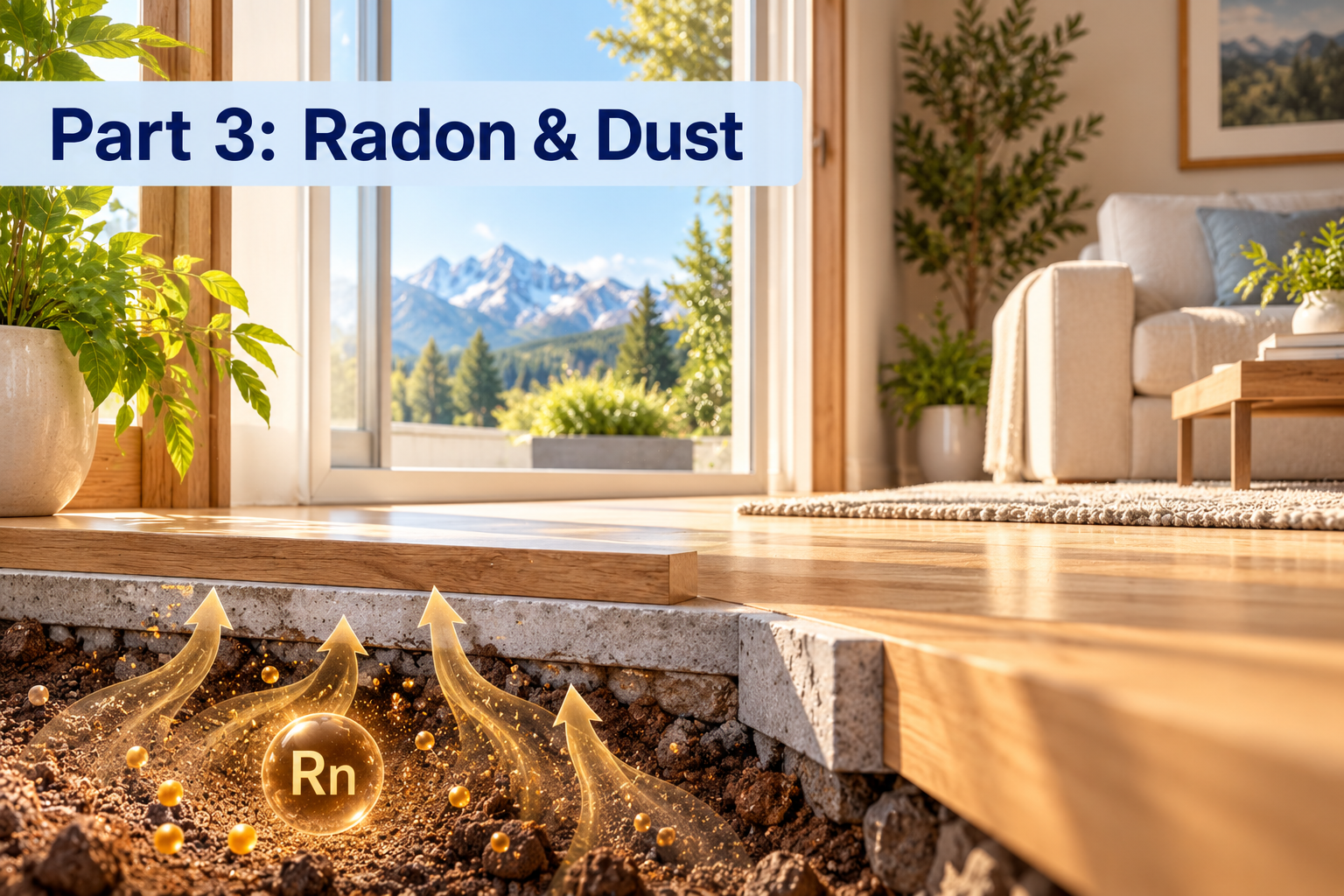
Radon Decay & Dust: What Can Air Filtration Actually Remove?
Part 3 of 3 | The Hidden Pollutants in Your Air: A Fresh-Air Filtration Series with LuLu
Did you know that radon gas can produce radioactive particles that attach themselves to airborne dust?
Hi, I'm LuLu! Welcome to the final chapter of our filtration series! We've explored arsenic-bearing dust and mold-related particles. Now, let's investigate what happens when radon decays, and what your air filters can actually catch! 🌹
What Happens When Radon Decays?
Radon is a colorless, odorless radioactive gas that can enter homes through foundations and openings in contact with the soil.
As radon undergoes radioactive decay, it produces radioactive substances called radon decay products, including polonium-218 and polonium-214.
These decay products can attach to tiny airborne particles, including household dust. When inhaled, they can release radiation that damages lung tissue and increases lung cancer risk.
Talk about some seriously unwanted dust passengers!
Can MERV 15 Filters Capture Radon Decay Products?
Yes, when the decay products are attached to particles the filter captures!
MERV 15 filters are highly effective at capturing fine particulate matter, including many dust particles carrying radioactive decay products.
However, there's one BIG difference:
- Radon gas: Cannot be captured by standard MERV particulate filters.
- Radon decay products: Can be captured when attached to airborne particles that pass through the filter.
Not all decay products are attached to dust, and filtration effectiveness depends on particle size and system design.
How UpgradeAirKit Filters Your Fresh Air
Here's the good news: UpgradeAirKit includes fine-particle filtration in its standard intake manifold!
- MERV 15: Captures fine airborne particles, including some that may carry radioactive decay products.
- Activated Carbon: Helps reduce certain gaseous pollutants and odors.
For homes in areas with elevated outdoor dust or particulate pollution, our optional Triple-Pack Filter Box adds a pre-filtration stage:
- MERV 8: Captures larger dust particles and helps protect the finer filter.
- MERV 15: Captures fine particulate matter.
- Activated Carbon: Helps adsorb certain gases and odors.
Three complementary filtration stages for incoming outdoor air!
It's important to remember that these are fresh-air intake filters. They do not directly filter radon decay products already circulating inside your home.
Can Balanced Fresh-Air Ventilation Help?
A balanced Energy Recovery Ventilator (ERV) brings filtered outdoor air inside while exhausting stale indoor air.
This air exchange can help dilute some indoor pollutants and may reduce indoor radon concentrations under certain conditions. However, results depend on the home, its radon entry pathways, and the ventilation system.
An ERV is not a substitute for dedicated radon mitigation.
Radon Testing and Mitigation Come First!
Because you can't see or smell radon, testing is the only way to know your home's radon level.
The EPA recommends taking action at 4 pCi/L or higher and considering mitigation between 2 and 4 pCi/L.
If levels are elevated, a qualified radon professional can recommend an appropriate mitigation system, commonly involving sub-slab depressurization to prevent radon from entering the home.
Filtration and balanced ventilation can complement a healthy indoor air strategy, but they do not replace radon testing or mitigation.
Don't Let Radioactive Dust Hitch a Ride!
Here's what we've learned: Radon is a gas, but its radioactive decay products can attach to dust particles. High-efficiency filters can capture some of those particles when they pass through the filter.
UpgradeAirKit's standard MERV 15 and activated carbon filters help clean incoming outdoor air, while our optional Triple-Pack Filter Box adds pre-filtration for more demanding particulate conditions.
Explore our filtration add-ons!
Test for radon. Filter your fresh air. Keep those unwanted dust passengers outside! 🌹
Explore the Complete Filtration Series!
Missed the earlier chapters? Explore Part 1: Arsenic & Fine Dust and Part 2: Mold & Mycotoxins to discover how airborne pollutants can travel on tiny particles and what filtration can capture.
Authored by LuLu & the UpgradeAirKit Team